

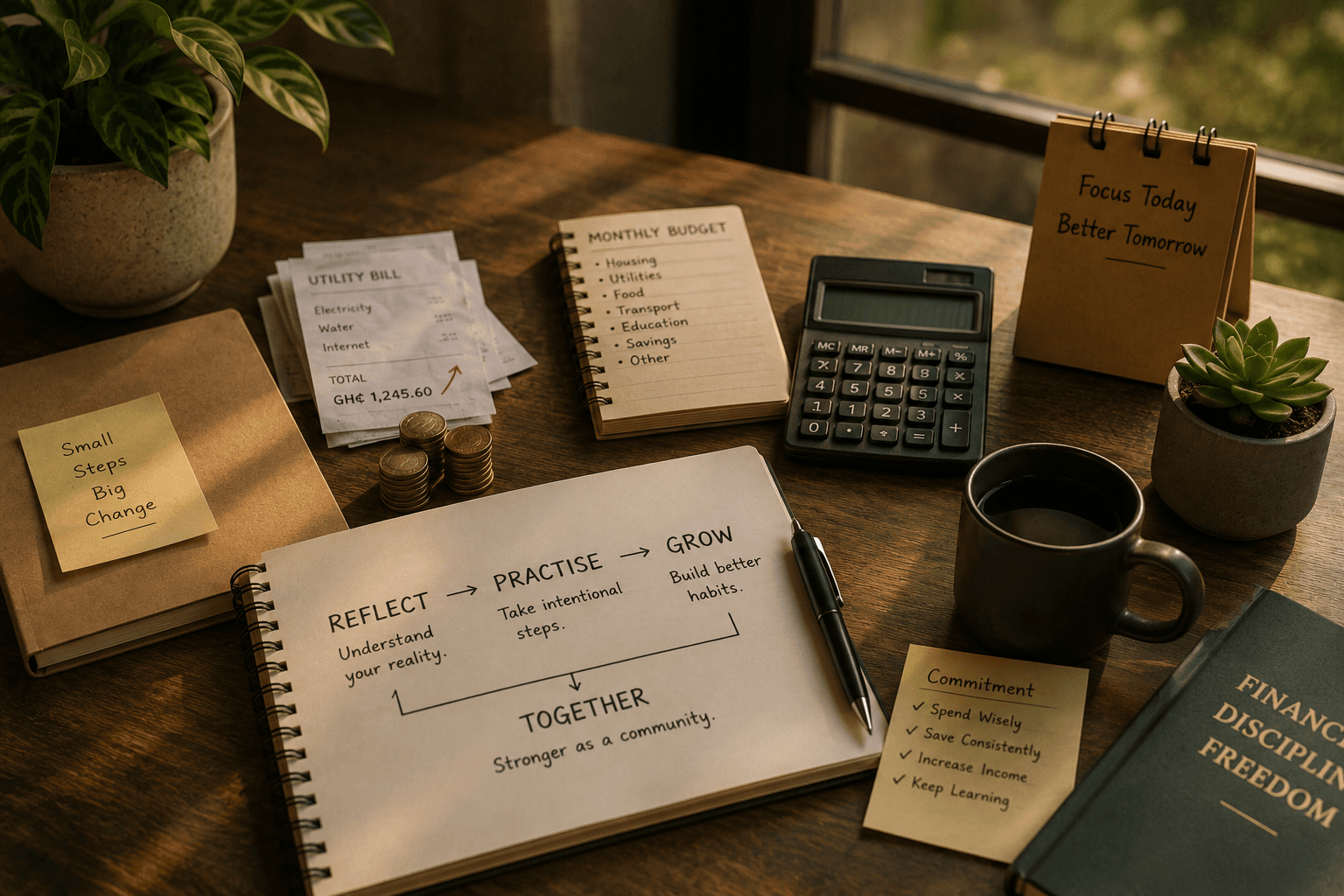
As the cost of living continues to influence everyday financial decisions, SPC's Finance Reflection and Practice Model began its pilot journey by asking a simple but important question: Are our financial habits changing with the realities around us? Rather than delivering a conventional financial literacy lecture, participants reflected on their own experiences, challenged their assumptions and explored how financial knowledge can translate into everyday practice.
Financial literacy is often discussed as something we need to learn.
But what happens when the financial realities of everyday life change faster than our habits do?
That was the question at the centre of SPC's inaugural Finance Reflection and Practice Model (FRPM) session, themed:
"The Cost of Living Is Changing — Are Our Financial Habits Changing With It?"
The session deliberately avoided the structure of a traditional financial literacy class. Instead, participants were presented with a real-life financial situation and invited to examine how they personally respond when the cost of meeting their needs increases.
The discussion quickly moved beyond the general state of the economy and into personal experience.
Participants reflected on how they manage expenditure, respond to financial pressure, use savings, consider borrowing and think about generating additional income. These experiences naturally brought several foundational financial principles into the conversation without requiring them to be introduced as predetermined lessons.
One particularly important insight was that financial difficulty cannot always be explained by poor spending habits.
For some people, the challenge may be that their income simply does not sufficiently match their financial responsibilities. This prompted reflection on another dimension of financial resilience: the ability to improve one's earning capacity alongside managing expenditure responsibly.
The conversation also explored preparedness.
Participants considered how they would respond to unexpected financial demands and whether their existing financial arrangements provide sufficient room to absorb such pressures. This brought saving, borrowing, financial preparedness and personal discipline into the discussion.
Rather than concluding with a list of financial rules, the session encouraged participants to consider what their own responses reveal about their financial habits.
That distinction is central to the FRPM.
The objective is not simply to know more about money.
It is to ask:
Does what I know about money actually influence what I do with money?
The pilot therefore represents more than the beginning of a financial literacy initiative. It is an attempt by SPC to practise its principle of self-introspection, examining ourselves before seeking to influence others.
The financial principles identified during the discussion included budgeting and expenditure management, earning and income generation, saving and continuous financial learning.
Most importantly, the conversation provides a foundation for the next stage of the model: practice.
The real measure of the session will not be how much participants remember from the discussion. It will be what they subsequently do differently, what they discover through that practice, and what they can reflect on when the group meets again.
That is where the Finance Reflection and Practice Model intends to distinguish itself.
Reflect. Practise. Review. Learn. Repeat.
Key Takeaways
- Financial pressure requires financial adaptation: Changing costs can require individuals to reconsider how they allocate, protect and generate their resources.
- Spending less is not the only answer: Financial resilience may require both better expenditure management and stronger income-generation capacity.
- Financial knowledge must translate into behaviour: Knowing what is financially responsible does not necessarily mean practising it.
- Saving provides room to respond: The discussion highlighted the importance of being prepared for unexpected financial demands rather than relying entirely on borrowing or last-minute adjustments.
- Real-life situations can teach financial principles: The pilot demonstrated that budgeting, saving, earning, borrowing and financial learning can emerge naturally from an open discussion about everyday experiences.
- Reflection is only the beginning: The real test of the FRPM will be whether participants convert reflection into practical changes in their financial behaviour.
What Members Committed To
Members committed to tracking one personal financial habit for two weeks ahead of the next session.
More from SPC